
State of Observability 2025: Driving Business Growth With Splunk
Updated: Jan 14
System outages still happen. Alerts still fire at the worst times. Meanwhile, customers expect fast, seamless digital experiences every day. As a result, many organisations feel stuck reacting to problems instead of improving outcomes.
In the past, observability mainly helped IT teams keep systems running. However, that role has changed. Today, observability shapes business decisions, customer satisfaction, and product innovation. Telemetry data now connects technology health to revenue and brand trust.
At Ingeniq, we work with organisations across Australia to build practical observability skills using Splunk. We see first-hand how teams shift from firefighting to insight-driven action when observability is done well.
In this article, we explore how observability has evolved in 2025, what Splunk’s latest research reveals, and why skills development plays a critical role in turning data into business growth.

What the State of Observability 2025 Reveals
Observability has reached a turning point. According to Splunk’s State of Observability 2025 report, high-performing teams no longer treat observability as a support function. Instead, they use it as a business catalyst.
Splunk surveyed 1,855 ITOps and engineering professionals across nine countries and 15 industries. The findings show a clear gap between leaders and laggards.
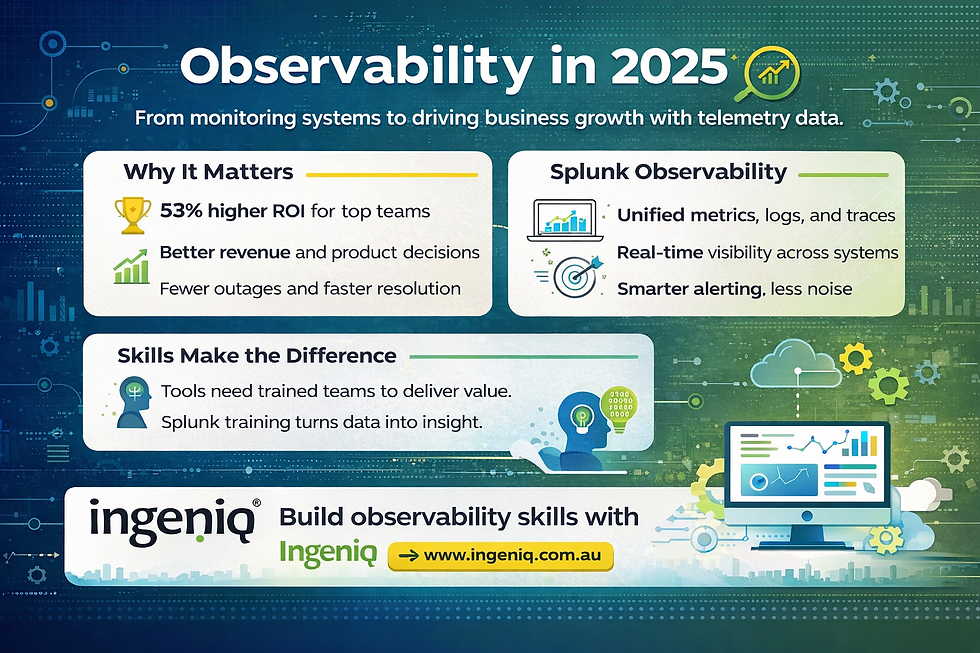
High-performing teams were nearly twice as likely to say their observability practices significantly improved revenue, employee productivity, and product roadmaps. In addition, these teams achieved 53% higher ROI than their peers.
These results highlight one truth. Observability maturity directly affects business performance. Therefore, the tools and skills behind observability now matter more than ever.
Observability as a Growth Driver
Modern businesses rely on software. Every release, update, and performance issue affects customer trust. As a result, observability data now informs far more than technical fixes.
Instead of asking, “What’s broken?”, leaders now ask, “What can we improve?” That shift changes how teams work. Observability insights guide product decisions, optimise customer journeys, and reduce friction across services.
The Splunk report found that 74% of organisations rate monitoring critical business processes as moderately to very important. Furthermore, 65% say observability positively impacts revenue. Meanwhile, 64% link observability directly to improved product roadmaps.
Clearly, observability has moved beyond infrastructure. It now supports growth, innovation, and long-term strategy.
The Technology Stack Behind High-Performing Teams
Technology choices shape observability outcomes. Leading teams invest in modern, flexible tooling that supports scale and complexity.
According to the research, top performers consistently use:
OpenTelemetry for standardised telemetry data
Observability-as-code for repeatable practices
Code profiling for deep performance insights
These teams also rely on Splunk Observability Cloud to unify metrics, traces, and logs across environments. This approach provides real-time visibility without siloed data.
With Splunk observability, teams gain a single view of application health, user experience, and system behaviour. As a result, they can detect issues earlier and respond with confidence.
However, technology alone is not enough. Without skilled people, even the best platforms fall short.
The Cost of Reactive Operations and Alert Fatigue
Despite progress, many teams remain trapped in reactive workflows. Alert fatigue continues to drain time, morale, and budget.
The Splunk report reveals that 43% of respondents spend too much time responding to alerts. Meanwhile, 20% frequently launch war rooms involving multiple teams. These practices slow resolution and increase costs.
Even more concerning, 73% of organisations experienced outages due to ignored or suppressed alerts. In most cases, poor alert quality caused the issue.
Alert hygiene plays a major role in observability ROI. In fact, 54% of respondents said alert detection quality has the greatest impact on observability returns.
Reducing noise and improving signal clarity helps teams focus on meaningful issues. Consequently, smarter alerting leads to faster resolution and fewer disruptions.
AI’s Expanding Role in Observability
Artificial intelligence brings both complexity and opportunity. On one hand, AI-powered systems behave unpredictably. On the other hand, AI tools enhance observability workflows.
According to the report, 48% of respondents say monitoring AI systems is harder than traditional workloads. These systems change rapidly and lack transparency. As a result, observability teams face new challenges.
However, AI also delivers strong benefits. 78% of respondents say AI enables them to spend more time on innovation instead of maintenance. This shift allows teams to focus on value-driven work.
AI-assisted observability supports faster root-cause analysis, improved anomaly detection, and better forecasting. When used correctly, it amplifies human expertise rather than replacing it.
Bridging Observability and Security
Observability and security now overlap more than ever. Shared telemetry data supports faster investigations and fewer blind spots.
The report found that 44% of high-performing teams strongly agree that ITOps and engineering collaborate closely with security teams. By comparison, only 29% of other teams reported the same level of collaboration.
This alignment delivers results. 54% say collaboration reduces wasted time chasing issues. Meanwhile, 64% report fewer customer-impacting incidents.
By unifying observability and security data, organisations improve resilience and trust. Therefore, cross-team collaboration has become essential.
Building Skills That Match the Future of Observability
Tools evolve quickly. Skills must evolve faster.
As observability grows more strategic, organisations need professionals who understand data observability, AI-driven insights, and modern telemetry frameworks. This is where Splunk training and Splunk certification play a critical role.
Splunk observability certification validates practical skills across real-world environments. It ensures teams can configure alerts, analyse telemetry data, and optimise performance at scale.
Through structured learning, organisations future-proof their workforce. They also reduce dependency on reactive problem-solving.
If your teams want to reduce alert fatigue and improve observability outcomes, Ingeniq can help through expert-led Splunk training and certification pathways. [Explore Splunk Training with Ingeniq]

How Ingeniq Helps Organisations Get More From Splunk
At Ingeniq, we help organisations maximise their investment in Splunk technologies. We focus on practical enablement rather than theory alone.
Our approach supports:
Observability maturity assessments
Hands-on Splunk observability training
Certification-aligned learning paths
Adoption of Splunk Observability Cloud
We work closely with teams to build confidence and capability. As a result, organisations gain faster insights and stronger outcomes.
By aligning tools, people, and strategy, Ingeniq helps teams move from reactive monitoring to proactive optimisation.
Conclusion: Turning Observability Into a Business Catalyst
Observability in 2025 is no longer optional. It directly influences revenue, customer experience, and innovation. Splunk’s research makes one thing clear. High-performing teams treat observability as a growth engine.
They invest in modern tooling, improve alert quality and collaborate across teams. Most importantly, they develop the right skills.
By combining Splunk observability, data observability, and continuous learning, organisations unlock real business value. Those who delay risk falling behind.
Ready to Build Observability Skills That Drive Growth?
Empower your teams with practical Splunk observability training and certification.
Learn how Ingeniq helps organisations turn telemetry data into measurable business outcomes.



Comments